
Vacant vs. Occupied Staging — What Every Orange County Realtor Needs to Know

When agents ask about vacant vs. occupied staging in Orange County — the answer is almost never one-size-fits-all.
One of the most common questions agents ask when they call Salt + Slate for the first time is a simple one —
"What kind of staging does my listing need?"

It is also one of the most important questions to get right. The difference between vacant staging and occupied staging is not just a matter of price or scope. It is a matter of strategy — and choosing the wrong approach for the wrong property can underdeliver on both investment and outcome.
Here is a clear breakdown of both services, when each one is the right call, and how to have that conversation with your seller before you go to market.
What Vacant Staging Actually Is
Vacant staging is exactly what it sounds like — a home with no furniture receives a complete furniture and accessories install. Salt + Slate brings in everything: sofas, beds, dining tables, rugs, lighting, art, and accessories — curated specifically for that property's architecture, price point, and target buyer.
The goal is to transform an empty property into a home that buyers can emotionally connect with — one that photographs beautifully, shows with purpose, and communicates value at every price point.
Vacant staging is the highest-impact option available.
When it is executed correctly — with the right furniture scale, the right buyer profile in mind, and the right sightlines considered — it changes the trajectory of a listing in ways that photographs alone cannot.
What Occupied Staging Actually Is
Occupied staging is a fundamentally different service. The home is lived in. The seller is still there. And the goal is not to fill an empty space — it is to edit, rearrange, and selectively enhance a space that already has furniture and personal belongings in it.

A professional occupied staging consultation involves:
Walking through every room with a critical eye for what the camera will see, what buyers will feel, and what is working against the listing rather than for it. Providing a specific, room-by-room recommendation list for the seller — what to remove, what to rearrange, what to add. Then, returning to install targeted accessories, art, and accent pieces that elevate the overall presentation without displacing the seller's life.
Done well, occupied staging is minimally disruptive, more affordable than vacant staging, and for homes that are already in good condition, often just as effective.
Vacant vs. Occupied Staging — How to Know Which One Your Listing Needs
This is the decision that most benefits from having your staging partner involved before the listing appointment rather than after. A 30-minute walkthrough changes everything about the recommendation.
That said, here are the clearest indicators for each.
Your listing likely needs VACANT STAGING when:
>The property is empty or will be vacant before listing. There is no furniture to work with and buyers will walk through hollow rooms that feel smaller than they are and colder than they should.
Your listing will be judged online before a single buyer walks through the door. Over 95% of buyers begin their home search online — and studies consistently show that listings with professional photography receive significantly more views, more saves, and more showing requests than those without. A vacant home photographs poorly by nature. Empty rooms flatten in photos, corners read as dead space, and scale is impossible to communicate without furniture as a reference point. Staged homes photograph entirely differently — the rooms have purpose, the light lands on things worth capturing, and buyers stop scrolling. If your listing photos are not stopping the scroll, the showing never gets scheduled.
>The home is a luxury property at a price point where buyer expectations are high. At $1.5M and above in Orange County, buyers have seen beautifully staged homes. An empty property at that price reads as neglected rather than neutral.
>The architecture or layout is the primary selling point. High ceilings, open floor plans, exceptional views — these features require furniture and scale to communicate properly. Without staging, buyers underestimate exactly what they are looking at.
>The listing has been sitting without activity. A vacant home that has been on the market for two or more weeks with minimal showing traffic is almost always a presentation problem first and a price problem second. Staging resets the listing.
>The seller has relocated or is managing from a distance and wants a clean, managed process with no involvement required on their end.
Your listing likely needs OCCUPIED STAGING when:
>The seller is still living in the home, and full vacant staging is not practical or necessary. The furniture is in reasonable condition, and the home has a good foundation to work from.
>The home is well-maintained but shows as "too personal." Family photos on every wall, collections throughout, religious items, children's artwork — all of it is personal and meaningful to the seller, and all of it needs to step back for the buyer.
>The listing is in a mid-market price range where the staging investment needs to be proportionate to the expected return. Occupied staging costs significantly less than vacant staging and, for the right property, delivers comparable photographic results.
>The seller needs to stay in the home through the listing period and is willing to follow a preparation checklist and make targeted changes before photography day.
>The home needs editing more than it needs filling. Sometimes the most powerful thing staging does is remove — reduce the visual noise, clear the surfaces, create breathing room — rather than add.
The Price Point Consideration
One of the most practical ways agents think about this decision is through the lens of the listing price versus the staging investment.
For vacant staging on an Orange County property, expect a professional install to range from approximately $4,500 for a smaller condo to $10,000 or more for a larger luxury home. The investment scales with the property size, the number of rooms staged, and the quality level of the install.
For occupied staging, expect a consultation fee plus an installation to range from approximately $1800 and up, depending on the scope of work and the number of rooms addressed.
Against a $900,000 listing, a $5,000 vacant staging investment is less than 0.6% of the sale price. As staging shortens the time on market or closes the gap on offer price, the math is straightforward.
And for sellers where upfront cost is the primary objection, Salt + Slate works with a financing partner that covers staging costs up to $75,000 with repayment at closing. Zero out-of-pocket before the sale. That removes the barrier entirely.

The Conversation With Your Seller
Once you have identified which approach is right for the listing, the conversation with the seller follows a consistent framework.
For vacant staging:
"Because the home will be empty, I am recommending a full staging install before we go to market. Buyers struggle to emotionally connect with vacant spaces — they underestimate the size of rooms and they cannot picture their life there. We are going to change that before the first buyer walks through the door."
For occupied staging:
"I am recommending an occupied staging consultation. We are not going to move your furniture out — we are going to edit what is here, move a few things strategically, and bring in some targeted pieces that will make the home photograph significantly better. It is minimally disruptive and the results make a real difference in the listing photos."
In both cases, introduce the recommendation before the pricing conversation, connect it directly to the buyer experience, and have the data ready for sellers who ask about the return.
What to Expect From the Salt + Slate Process
Whether the listing is vacant or occupied, the process Salt + Slate follows is consistent and designed to make the agent's job easier at every step.
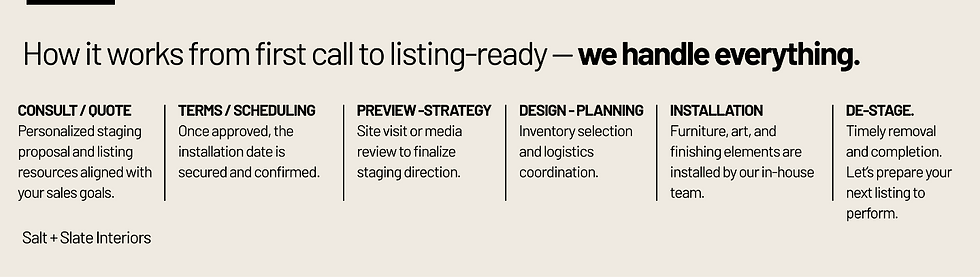
For vacant staging, the process moves from initial walkthrough and proposal through contract, install, and photography-ready confirmation — typically executable within one to two weeks of engagement.
For occupied staging, the process begins with a walkthrough and detailed room-by-room recommendation list, followed by a seller preparation period, and then a single-day styling install before photography.
In both cases, Salt + Slate coordinates directly around the agent's listing timeline. The install is not scheduled around our availability — it is scheduled around your go-live date.
If you have a listing coming up and want to talk through which approach makes the most sense, that conversation takes fifteen minutes, and we are always glad to have it.
About Salt + Slate Interiors
Salt + Slate Interiors provides intentional vacant and occupied home staging services across Orange County and North San Diego County. We partner directly with listing agents and their sellers to ensure every home goes to market positioned to compete — and to close.
Services:
Vacant Home Staging · Occupied Staging Consultation · Listing Strategy Walkthrough · Co-Marketing Support ·
Notable Financing — Pay at Closing up to $75,000.
Ready to talk about your next listing? We'd welcome the conversation. https://www.saltandslateinteriors.com/quick-connect
714.464.7626 @saltslateinteriors · @lori.m.carlisle
Serving Orange County and North San Diego County.
